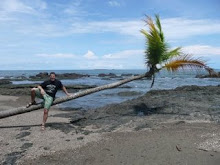
Even though we were only in Puerto Viejo for 12 hours, we were still able to enjoy the culture. For dinner, we went to a local restaurant called Lidia's Place. There we were able to enjoy some Caribbean food which included, chicked, and rice & beans. The following pictures is of Nate and I on our way back to the hotel on the bus.
Monday, June 9, 2008
The Show!
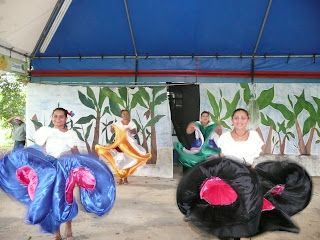
As you can see above, these are few pictures of The Chiquita Banana Show. It was kinda of an awkward show not only because they all spoke Spanish and I had no idea what they were saying, but also because they pulled us out of the audience to dance with them. However, it was a fun show to watch. Also, while we were there they offered us all packets full of information about Chiquita and the business industry in Costa Rica.
First, I would like to start out with a brief history of Chiquita. Well, in 1899, United Fruit Company became an established corporation. Then, in 1903, the were listed on the New York Stock Exchange. However, it was not until 1944 that the name Chiquita, the Miss Chiquita character, and the jingle all came about. It is interesting to note here that Chiquita actually means little girl. Finally, there were two huge events that occured during the 1960's that will impact the company forever. First, they began to use cardboard boxes for shipping which allowed for protection between locations. Second, they began to sell in Europe which opened up a whole new market. However, I want to focus more social responsibiliy & environmental responsibility.
According to Chiquita, all of their Latin American farms conform to certain standards, which includes: no child labor, safe working conditions, no harsh treatment, maximum of 48 hours a week, and compensation meets the legal minimum. While visiting the plantation, all of those requirements were being met. However, it is important to address what the minimum wage in Costa Rica is. Currently, Chiquita is paying their employees $13 a day, which is 50% greater than most plantations in Costa Rica. That fact truly put it in perspective for me to see how hard these people were working for the amount of money they were making. I am truly blessed with the opportunities that I have been given.
I also wanted to address the environmental aspect as well. According to Chiquita, their farms concorm to strict standards such as: minimal pesticide use, protection of wildlife, conservation of water and soil, environmental education, fair pay, safe working conditions, and no tolerance for deforestation. While must of these issues are important, that statement continues to show me that Chiquita is still not ready to become sustainable. For example, they specifically mention minimal pesticide use. If there is no demand for another solution to this big problem, then it will never happen. Also, as I mentioned in a previous blog, they continue to waste water and release them into the environement with harmful chemicals. However, they are making strides.
The company has planted at least one million trees along rivers, lakes, roads and in residential and industrial areas to try and help offset their actions that are harming to the environment. Also, at Chiquita they minimize the water that contains pesticides from spreading unlike many other banana plantations. Even though they are not perfect, I believe that they realize that sustainability is important and they are making steps to become more environmentally friendly. Overall, it is not going to help the environment if only one company makes a change, we must all make a change to become more sustainable.
Information from: Chiquita
The Process!
Our visit to the Chiquita banana plantation on Friday, June 6, 2008 was not only interesting, but also informing. The first thing that I noticed when pulling into the plantation was a sign warning people of the hazardous materials that are used on the plants. I had a feeling I was going to find such a sign due to previous research, however I didn’t expect to see homes of people right across the street. It is important to note that the reason that they must use the chemicals is because the plant is foreign to Costa Rica and therefore needs them to survive. The banana plant was actually brought over from Asia.
After lunch, we were able to take a tour to see the process of how the bananas are produced. First, they must grow and nuture the plant which can take up to a year in time. After, the plant begins to produce the fruit – bananas. However, as you can see in the pictures above Chiquita must use plastic bags in order to protect the fruit from insects/fungi. At least at Chiquita, those plastic bags are recycled after their use, however there are some plantations that don’t even do that. Next, the workers (who are payed $13 a day) pick the bananas, and take them to be cleaned. As you can see above, the good bananas are sent through a cleaning process. The water that is sprayed on them contains a toxic chemical – chlorine to rid the bananas of a natural latex. Next, the bananas are boxed and ready to be shipped anywhere around the world. However, what I found most interesting is that the water that is used to clean the bananas is then wasted. The most efficient process would be to clean the water and recycle it again to clean the bananas. Yet, the water containing chlorine, is sent out and into a creek, which is ulimately effecting and harming the surronding environment. Even though Chiquita is using a “less bad” approach compared to its competitors, it still isn’t using a complete cradle to cradle method.
There are numerous benefits that they could reap if they were willing to think “outside the box” and think sustainable. As a matter of fact, I don’t even think the guides could even answer our questions that related to sustainability. Some of the benefits that they could see if Chiquita was willing to make some changes would include: reduce costs (for example, the reuse of water), reduce risk and liability, and an increase in labor production and financial performance. Overall, they must shift their eyes from the short-run to the long-run. Also, not just on their customers, but also the environment and their stakeholders.
Chiquita!
Well, after leaving La Selva Research Station, we headed for a visit to a Chiquita banana plantation on Friday, June 6, 2008. Even though I will go into more detail of how the process actually works in my next post, I wanted to post a few personal pictures from the visit. As you can see, the first few pictures are just of the welcome sign and me. The fourth picture is of the largest banana I have ever seen! (too bad it was fake.) Overall, it was a wonderful time there, especially since they offered us banana bread for lunch! So good!
La Selva Research Station!
After our visit to the OSA, we were back on the road again. We were gone from Thursday, June 5 to Monday, June 9, 2008. On Thursday, we spent the night at La Selva Research Station. There we were able to once again take part in eco-tourism and learn more about the rainforest.
Well, how did La Selva Research Station come about? According to Costa Rican Guide, Dr. Leslie Holdridge established La Selva as a study site on mixed plantations for the improvement of natural resources management in 1954. Since its purchase in 1968 by the Organization for Tropical Studies it’s been declared a private Biological Reserve and grown into one of the premier sites in the world for research on tropical rain forest. It is located in the Caribbean lowlands and bracketed by the Sarapiquà and Puerto Viejo Rivers, La Selva is covered with what is technically known as tropical pre-montane wet forest and more commonly referred to as rainforest. There is no better place in Costa Rica to learn about this ever more endangered ecosystem.
Once again, I come to realize how much Costa Rican depends on eco-tourism to help sustain its economy. It truly is everywhere around this small country. The trip to La Selva was truly a wonderful and learning experience. To help explain what I learned on the trip, I am going to describe the pictures taken while I was there.
The first couple pictures are of me while on the hike. The next picture is of our guide who was showing us a birds nest that had fallen to the ground. The red frog above, is called the poison dart frog, because the poison that it creates and how it was once used on the tips of darts during battle. If the dart didn't kill them, the poison would. The next picture is of a bullet ant, which is the largest ant that I have every seen & they can be extremely painful if they sting you (luckily I don't know from experience). The next picture is some of the wild hogs that were at the location. However, they weren't very wild. If you look closely at the seventh picture you can see a monkey! It was really cool to see them because they were loud and would swing from tree to tree. Overall, it made me think how sustainable the entire process of the rainforest is. Nothing is wasted and everything relies on one another. We can truly learn from these different processes if we one day want to live in a completely sustainable world.
Random!
I wanted to post these two pictures because these two signs are very different from ones found in the US and they are everywhere in Costa Rica. The first is obviously a stop sign that reads, "Alto", for stop. The second, is a sign of the national beer of Costa Rica - Imperial. You literally can not go to a different town and not see this sign. Almost every bar has it outside their store. This bar is called El Pescadito, which was the bar right around the corner from my host family's home and where all the Miami students went for a drink.
Makol
After leaving the OSA, we made our way back to San Jose. Even though we were only there for a short time, we were able to stop at a local medical supply distribution company, named Makol. Overall, this company was the middle man between large developed countries like the USA and ones in Europe to less developed countries like ones in Central America. Their objective was to import and export as many supplies that they could while fulfilling all of their requirements, and keeping a low inventory. It was very interesting to see how a small company, like Makol, is trying to conform to the regulations of so many different countries, while still being profitable.
Subscribe to:
Posts (Atom)